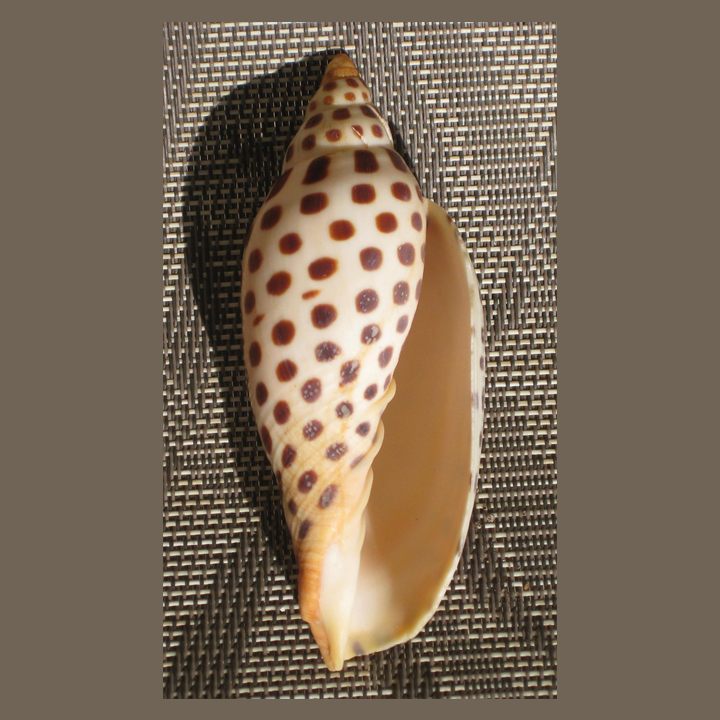
Photo: Bradeos Graphon, Public domain, via Wikimedia Commons
Junonia
- Typical size
- 3.0 – 5.5 in (7 – 14 cm)
- Group
- Gastropod (sea snail)
- Rarity
- Holy Grail
- Habitat
- Deep offshore waters (90–400 ft / 27–122 m); washed up only after severe storms
The undisputed crown jewel of North American beachcombing. Known for its immaculate ivory porcelain surface decorated with distinct square mahogany brown spots arranged in pristine spiral rows.
Quick answer · Quick Identification Verdict
The Junonia (Scaphella junonia) is a legendary deep-water predatory volute characterized by an elegant ivory-to-cream spindle shape decorated with precise spiral rows of square mahogany-brown spots. Because living populations dwell far offshore at depths of 90 to 400 feet, intact shells wash onto Southwest Florida beaches almost exclusively after powerful winter cold fronts or tropical storms.
Junonia key facts
| Scientific name | Scaphella junonia (Volutidae (Volute snails)) |
|---|---|
| Typical size | 3.0 – 5.5 in (7 – 14 cm) |
| Rarity | Holy Grail |
| Where it lives | Deep offshore waters (90–400 ft / 27–122 m); washed up only after severe storms |
| Best chance to find one | Winter cold fronts, post-hurricane swells, negative low tides at Bowman's Beach. |
| Opening | Right-opening (Dextral) |
| OK to collect? | Only if it is empty. If an animal is inside, return it to the water. Live shelling is banned in Lee County, Florida (Sanibel, Captiva, Fort Myers Beach). |
How to identify a Junonia: Diagnostic Field Checklist
Confirm your find against these primary diagnostic characteristics:
- Slender, fusiform (spindle-shaped) shell with a high, tapering spire
- Immaculate cream or ivory porcelain enamel with zero axial ribs or shoulder thorns
- Precise spiral bands of square to rectangular chocolate-brown or mahogany spots (5–7 rows on body whorl)
- Elongated, smooth aperture with 4 to 5 subtle oblique columellar folds (plaits)
- Bulbous, smooth apex (protoconch) resulting from direct embryonic development
Key Diagnostic Anatomy
Tap to collapse / expand
Examine these anatomical features to distinguish this specimen with certainty:
- Shape & Profile: Elongated fusiform spindle with gently convex whorls tapering to a smooth, bulbous apex. Volutids undergo direct embryonic development within egg capsules, producing a distinct button-like protoconch rather than a fine multi-whorled planktonic tip.
- Aperture & Lip: Narrow and elongated, spanning more than half the total shell length. The outer lip is thin, smooth, and gently arched without teeth, ridges, or exterior thickening. The interior is glazed in pale ivory porcelain.
- Columella (Inner Pillar): Straight inner lip bearing 4 to 5 distinct oblique plicae (folds) that angle downward into the aperture, serving as muscle anchors for the volute's body.
- Coloration & Markings: Deep reddish-brown to dark chocolate squarish blotches spaced evenly along spiral cords. The background ranges from warm cream to pale porcelain white.
Identifying Worn, Weathered & Broken Finds
Beach-tumbled Junonia fragments ('shards') are coveted finds in their own right. Even when wave action has ground away the spire or broken the outer lip, look for: (1) rectangular chocolate spots that remain distinctly square rather than mottled, (2) the thick, smooth porcelain-like wall cross-section, and (3) oblique parallel ridge folds on the inner columellar pillar. Unlike bonnet or cone fragments, worn Junonia shards never show exterior ribs or an umbilical groove.
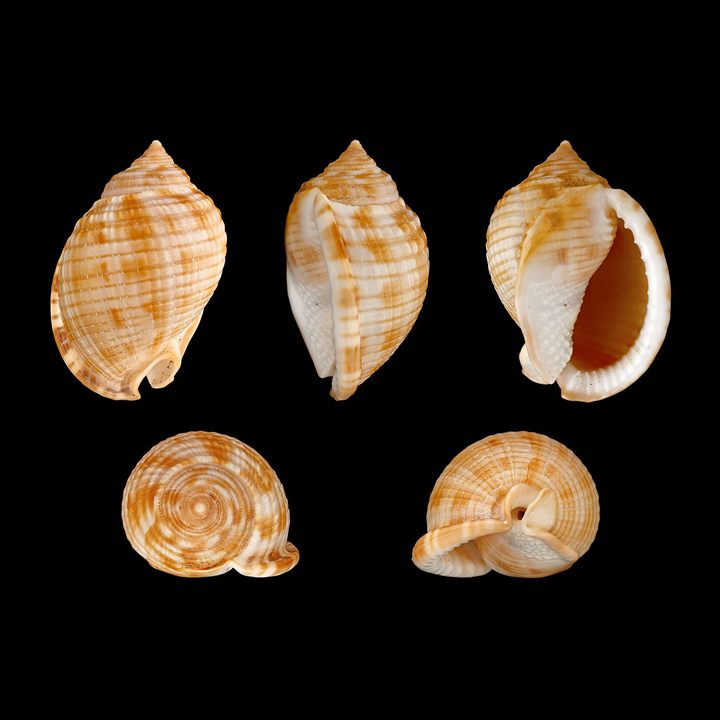
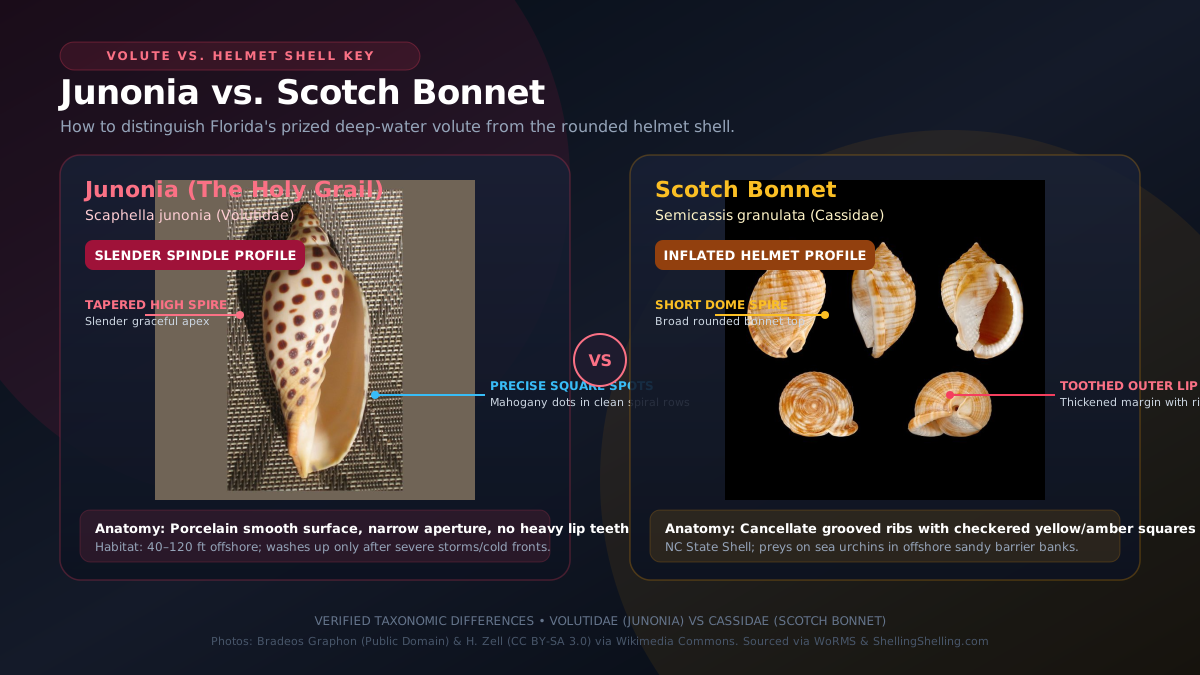
Diagnostic Visual Key: Junonia Volute vs. Scotch Bonnet Helmet
Slender spindle shape with toothless lip and columellar plicae vs. rounded globose helmet with toothed outer lip.
Common Lookalikes & How to Tell Them Apart
Scotch Bonnet
Rounded, globe-like helmet shell with checkered golden-amber patches across grooved spiral cords and a heavily thickened, toothed outer lip.
Alphabet Cone
Inverted triangular cone shell with a flat, stepped spire, narrow slit-like aperture, and irregular letter-like reddish-brown spots.
Distribution, Depth & Regional Reality
Geographic Range: Western Atlantic and Gulf of Mexico, ranging from North Carolina south around the Florida Peninsula to the Texas coast and Campeche Bank, Mexico.
Southwest Florida Reality: Junonias do not live near the shoreline. Their native benthic habitat begins miles offshore on deep continental shelf plains (typically 30–120 m / 100–400 ft depth). Living volutes never inhabit Sanibel or Captiva shallows. Beach finds occur when severe offshore turbulence—such as winter nor'easters, sustained northwest gales, or tropical storms—dislodges dead shells from benthic sand and rolls them inward over days or weeks. Bowman's Beach, Silver Key, Blind Pass, and Cayo Costa State Park are historic hotspots because of their outward-curving Gulf exposure.
Realistic Search Timing: Finding a whole Junonia on the beach is an extraordinary, once-in-a-lifetime occurrence for most beachcombers. Plan searches during major winter cold fronts with negative morning tides, walking shell drift troughs at first light immediately after sustained onshore winds subside.
Recognizing Living Animals & Conservation Regulations
How to check if the shell is alive or occupied
Volutes lack an operculum (trapdoor). A living specimen washed ashore will possess a large, fleshy, mottled foot that withdraws deeply into the aperture, often with moist mantle tissue or an extended siphon visible.
Florida Wildlife Rules & Local Shelling Ordinances
Under Florida Wildlife Code and Lee County Ordinance 89-08 (applicable across Sanibel, Captiva, and Fort Myers Beach), the harvesting of any living marine snail or mollusk is strictly illegal and subject to citations and fines. If an animal is present inside, immediately and gently place it into waist-deep water beyond the surf break.
Junonia: common questions
How do I identify a Junonia?
The Junonia (Scaphella junonia) is a legendary deep-water predatory volute characterized by an elegant ivory-to-cream spindle shape decorated with precise spiral rows of square mahogany-brown spots. Because living populations dwell far offshore at depths of 90 to 400 feet, intact shells wash onto Southwest Florida beaches almost exclusively after powerful winter cold fronts or tropical storms.
Where and when are you most likely to find a Junonia?
Winter cold fronts, post-hurricane swells, negative low tides at Bowman's Beach.
What is the Junonia most often confused with?
The Scotch Bonnet. The Scotch Bonnet is spherical and helmet-shaped with teeth inside the lip, whereas the Junonia is a slender, smooth spindle with a high spire and un-toothed lip.
Can I collect a Junonia in Florida?
Only if it is empty. If an animal is inside, return it to the water. Live shelling is banned in Lee County, Florida (Sanibel, Captiva, Fort Myers Beach).
Scientific Review & Authoritative Sources
Tap to view citations & review criteria
Primary Authoritative References
- World Register of Marine Species (WoRMS): WoRMS taxon details for Scaphella junonia (Lamarck, 1804), AphiaID 420170.
- Bailey-Matthews National Shell Museum: Sanibel Seashell Guide: Scaphella junonia distribution and ecology.
- Lee County Code of Ordinances: Chapter 14: Lee County Ordinance 89-08 / 04-20: Marine Mollusk & Live Shelling Conservation Regulations.