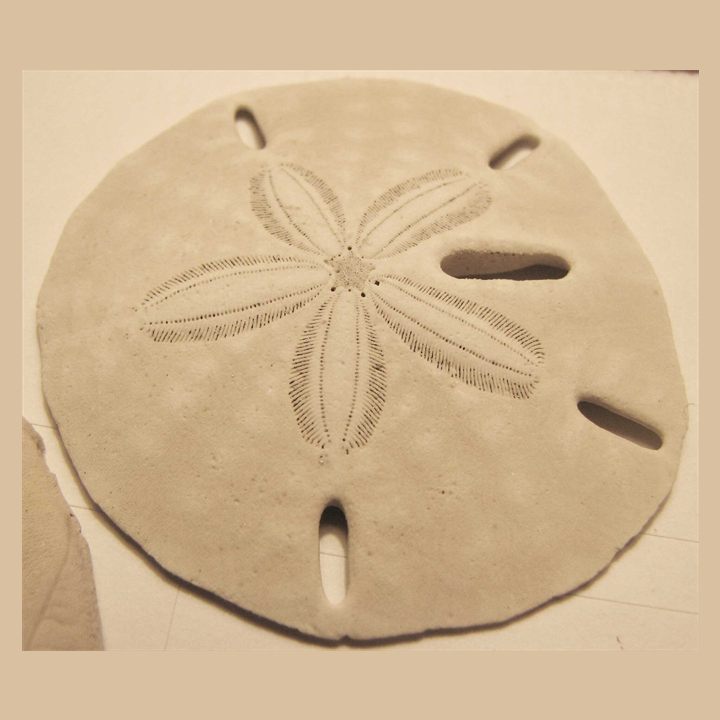
Photo: Sharon Mooney (see User:Edwardtbabinski), CC BY 2.5, via Wikimedia Commons
Keyhole Sand Dollar
- Typical size
- 2.5 – 5.0 in (6 – 13 cm)
- Group
- Echinoderm (sand dollar)
- Rarity
- Uncommon
- Habitat
- Subtidal sandy bottoms just beyond the low-tide wave break
The delicate skeleton (test) of a burrowing sea urchin. Displays a distinctive five-petaled floral pattern and five narrow elongated slots (lunules) that stabilize it against swift surf currents.
Quick answer · Quick Identification Verdict
The Keyhole Sand Dollar (Mellita tenuis) is a specialized, burrowing echinoderm—not a mollusk seashell. Its collected 'shell' is actually an internal rigid skeleton called a test, composed of thousands of fused calcium carbonate plates. Featuring a five-point petaloid floral pattern and exactly five narrow keyhole slots (lunules) that anchor it against wave turbulence, it is one of the Gulf Coast's most beloved and legally protected marine treasures.
Keyhole Sand Dollar key facts
| Scientific name | Mellita tenuis (Mellitidae (Keyhole sand dollars / Class Echinoidea)) |
|---|---|
| Typical size | 2.5 – 5.0 in (6 – 13 cm) |
| Rarity | Uncommon |
| Where it lives | Subtidal sandy bottoms just beyond the low-tide wave break |
| Best chance to find one | Calm mornings during extreme spring low tides on sheltered sandbars. |
| Opening | Not applicable (Echinoderm test with 5 lunules) |
| OK to collect? | Only dead, sun-bleached white tests. A living sand dollar (dark, fuzzy, with moving spines) must be returned to the water. |
How to identify a Keyhole Sand Dollar: Diagnostic Field Checklist
Confirm your find against these primary diagnostic characteristics:
- Biological identity: Echinoderm test (rigid internal skeleton), NOT a mollusk shell
- Ultra-flat circular disc with five distinct elongated keyhole slots (lunules)
- Five-petaled floral star pattern (petaloid ambulacra) centered on top surface
- Dead test is sun-bleached chalk-white, brittle, and completely bare of spines
- Living animal is dark purplish-brown or olive-gray with thousands of moving velvet micro-spines
Key Diagnostic Anatomy
Tap to collapse / expand
Examine these anatomical features to distinguish this specimen with certainty:
- Biological Distinction: Unlike snails or clams that secrete an external shell via an outer mantle, sand dollars are echinoderms (phylum Echinodermata) related to sea urchins and sea stars. Their test is an endoskeleton made of interlocking micro-plates of calcite (stereom) located beneath a thin living epidermis.
- Lunules (Keyhole Slots): Exactly five narrow perforations penetrate entirely through the test. These 'keyholes' serve as hydrofoil slots: when strong surf rolls over the sea floor, water channels upward through the slits, equalizing pressure and preventing the flat dollar from being swept up and flipped over.
- Petaloid Flower: The central 5-petal flower pattern consists of paired rows of microscopic pores through which the living sand dollar extends specialized respiratory tube feet (podia) to absorb oxygen from the water.
- Underside (Oral Surface): The flat underside (oral surface) features five branching food grooves radiating outward from the central mouth, lined with cilia that sweep microscopic algae, diatoms, and organic particles into its digestive system.
Identifying Worn, Weathered & Broken Finds
Because sand dollar tests are fragile, wave energy often breaks them into curved wedge-shaped segments. You can identify genuine sand dollar shards by looking at the broken edges: (1) internal support pillars (trabeculae) form a honeycomb-like network between the upper and lower plates, (2) the smooth rounded lip of a lunule slot is often preserved on one edge, and (3) the microscopic porous texture of calcium carbonate feels like fine pumice rather than the slick enamel of a gastropod.
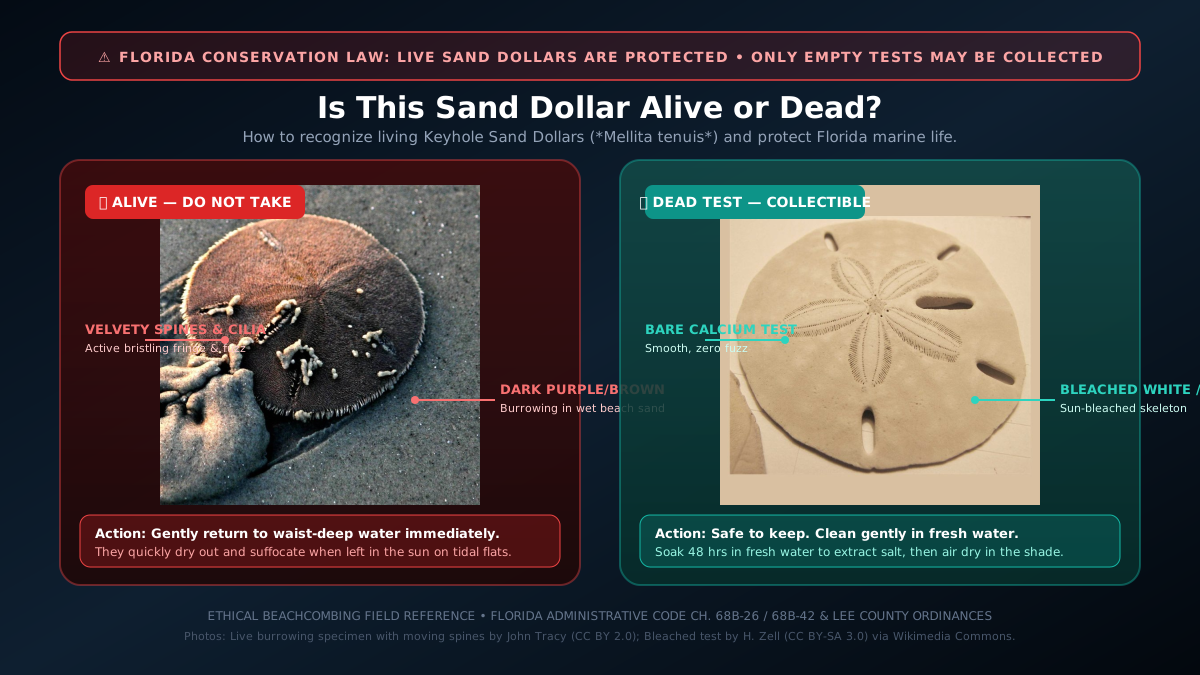
Diagnostic Visual Key: Living Sand Dollar vs. Empty Dead Test
Look for dark velvet cilia and moving spines (alive, must stay in water) versus chalky white bare calcium (empty test, legal to collect).
Common Lookalikes & How to Tell Them Apart
Six-Keyhole Sand Dollar
Tropical sand dollar possessing exactly six narrow keyhole slots instead of five; native to the Florida Keys, Bahamas, and Caribbean.
Sea Biscuit
Thick, inflated, dome-shaped echinoderm test with five petals but zero keyhole slots; common in grass beds in the Keys and Caribbean.
Distribution, Depth & Regional Reality
Geographic Range: Endemic to the Gulf of Mexico and the western coast of the Florida Peninsula, from Cedar Key and Tampa Bay down through Sanibel, Naples, and Marco Island.
Taxonomic Note: Older regional field guides frequently labeled all local specimens as Mellita quinquiesperforata. In 2013, morphological and genetic research (Coppard, Zigler & Lessios) confirmed that Mellita tenuis is the distinct, valid species throughout Florida's Gulf Coast, with narrower lunules and specific plate arrangements distinguishing it from the Atlantic/Caribbean M. quinquiesperforata.
Southwest Florida Reality: Sand dollars inhabit shallow sandbars and tidal lagoon flats in enormous colonies. They thrive in gentle surf zones off Sanibel's Tarpon Bay Beach, Blind Pass sandbars, and Marco Island's Tigertail Beach / Sand Dollar Spit.
Realistic Search Timing: Look for empty sun-bleached tests during extreme negative spring low tides in early morning. They often sit exposed on emergent sandbars or washed into the high-tide weed wrack after gentle offshore breezes.
Recognizing Living Animals & Conservation Regulations
How to check if the shell is alive or occupied
LIVE VS. DEAD TEST CHECK: (1) Color: A living sand dollar is dark purplish-brown, olive-tan, or grayish-green. A dead test is bleached chalky white or pale bone-tan. (2) Texture & Movement: Place the specimen flat on your wet palm; if it is alive, you will feel thousands of tiny bristly spines moving gently like velvet fuzz. (3) Pigment: Living dollars secrete a yellowish echinochrome pigment that harmlessly stains wet fingers.
Florida Wildlife Rules & Local Shelling Ordinances
FLORIDA CONSERVATION LAW: Under Florida Administrative Code (F.A.C.) Rule 68B-26.004, F.A.C. Chapter 68B-42, and Lee County Ordinance 89-08 / 04-20, taking a live sand dollar is strictly illegal. Violations carry substantial fines and misdemeanor citations. Never take a sand dollar that has color or moving spines; immediately return it into knee-deep water and gently set it flat on the sandy sea floor.
Keyhole Sand Dollar: common questions
How do I identify a Keyhole Sand Dollar?
The Keyhole Sand Dollar (Mellita tenuis) is a specialized, burrowing echinoderm—not a mollusk seashell. Its collected 'shell' is actually an internal rigid skeleton called a test, composed of thousands of fused calcium carbonate plates. Featuring a five-point petaloid floral pattern and exactly five narrow keyhole slots (lunules) that anchor it against wave turbulence, it is one of the Gulf Coast's most beloved and legally protected marine treasures.
Where and when are you most likely to find a Keyhole Sand Dollar?
Calm mornings during extreme spring low tides on sheltered sandbars.
What is the Keyhole Sand Dollar most often confused with?
The Six-Keyhole Sand Dollar. Count the slots: Mellita tenuis has 5 lunules; Leodia sexiesperforata has 6 lunules.
Can I collect a Keyhole Sand Dollar in Florida?
Only dead, sun-bleached white tests. A living sand dollar (dark, fuzzy, with moving spines) must be returned to the water.
Scientific Review & Authoritative Sources
Tap to view citations & review criteria
Primary Authoritative References
- World Register of Marine Species (WoRMS): WoRMS taxon details for Mellita tenuis Clark, 1940, AphiaID 513374.
- PubMed: Coppard, Zigler & Lessios (2013): Phylogeography and taxonomy of the sand dollar genus Mellita in the Gulf of Mexico (Molecular Phylogenetics and Evolution).
- Florida Fish and Wildlife Conservation Commission (FWC): Florida Administrative Code Chapter 68B-26 & Chapter 68B-42: Marine Life and Shell Regulations.