Is This Sand Dollar Alive or Dead?
How to tell if a Keyhole Sand Dollar (Mellita tenuis) is alive or dead: Living cilia velvet vs bare calcium test, movement test, and Florida wildlife harvesting laws.
The 3-second field test: If the sand dollar has a dark purplish, greenish, or brown fuzzy coat of velvet-like spines that move against your palm, or if it stains your skin yellow-green, it is 100% ALIVE. You must return it immediately and gently to the water. An empty test is completely bare, white or light tan, rigid, smooth, and free of any fuzz or movement.
Field Diagnostic Sequence: Alive vs. Empty Test
Under Florida conservation law (F.A.C. Rule 68B-26.004, Chapter 68B-42, and Lee County Ordinance 89-08 / 04-20), harvesting live sand dollars is strictly illegal. Use this 3-step field sequence before removing any specimen from the beach:
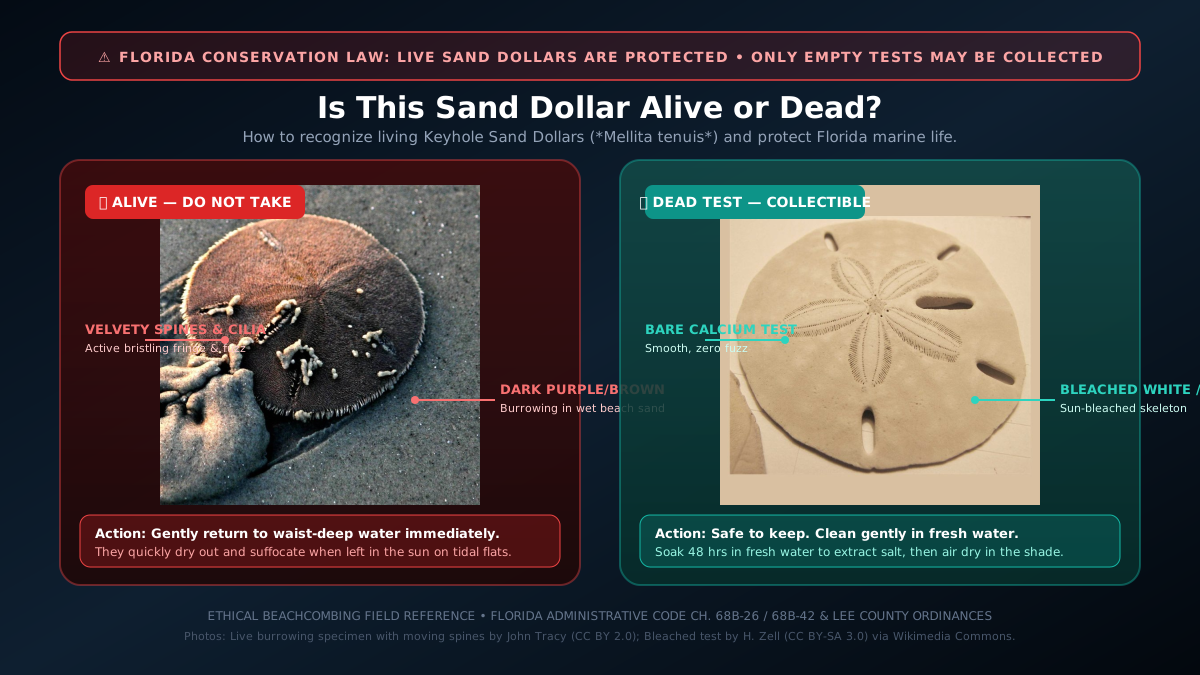
Observable Living vs. Empty Test Diagnostic Checks
Perform these three physical checks directly at the water's edge:
Look at Color & Surface Texture
Living: Covered in a dense, uniform velvet-like fuzz (thousands of tiny movable spines and microscopic cilia). Color ranges from dark purplish-brown and reddish-chocolate to greenish-grey or olive-tan.
Dead / Empty Test: Completely bare, chalky white, pale ivory, or sun-bleached grey. The surface feels smooth or finely stippled like sandstone, with zero velvet fuzz.
The 15-Second Palm Movement Check
Living: Place the specimen flat on your open, damp palm and hold completely still for 15 to 20 seconds. The tiny spine hairs will rhythmically ripple or tickle against your skin as the animal seeks traction to burrow.
Dead / Empty Test: Entirely motionless. No spine rippling, no prickling sensation, and no response to touch.
Check for Echinochrome Skin Staining
Living: Living sand dollars produce a harmless, water-soluble pigment called echinochrome. Gently handling a living specimen frequently leaves a yellowish-green or purplish stain on your fingers.
Dead / Empty Test: Leaves zero pigment or stain on your hands. The bare calcium carbonate matrix is completely inert.
Real Specimen Photographic Comparison
Authentic field photographs showing the dramatic difference between an active living animal and an empty, sun-bleached calcium test:
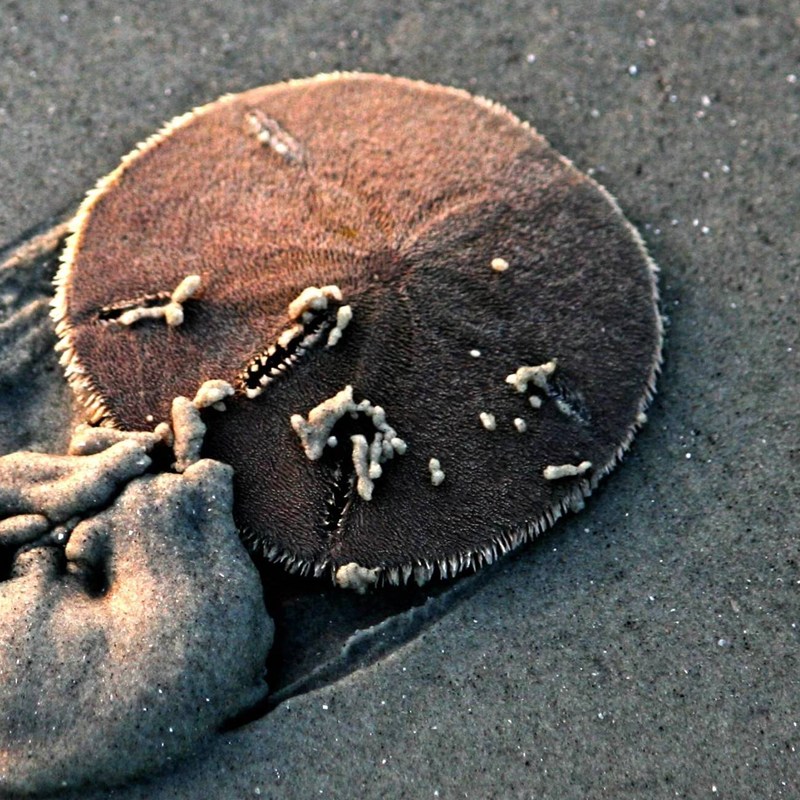
Living Keyhole Urchin (Mellita tenuis)
Authentic living Keyhole Urchin (Mellita tenuis) photographed in Sarasota, FL (Ryan Hodnett, CC BY-SA 4.0). Note the dense purplish velvet coat of spines and active tube feet.
Action: Must remain submerged in sea water or return gently beneath the swash zone.
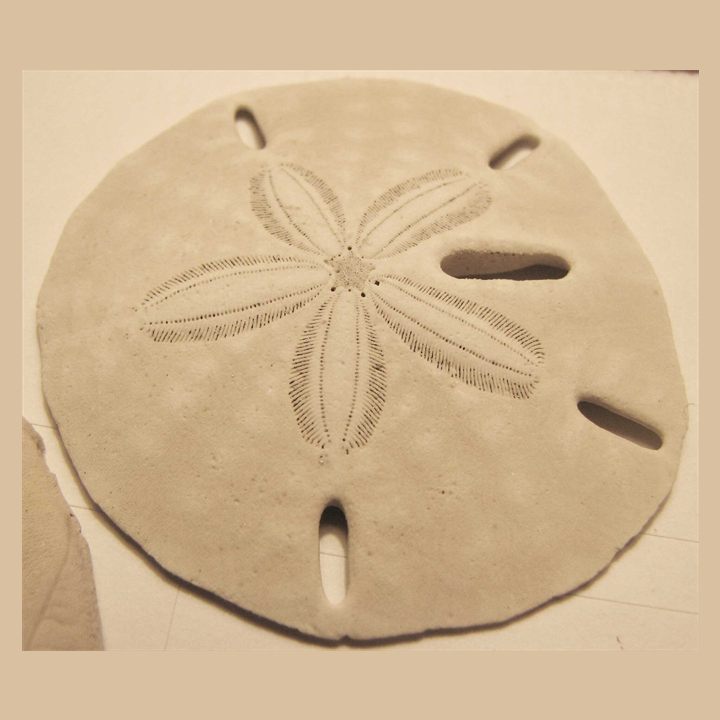
Sun-Bleached Test (Dead Skeleton)
Sun-bleached empty calcium test (Didrick Roggemann, CC BY-SA 3.0). The animal has naturally decomposed, leaving a bare white calcite stereom skeleton with five lunules.
Action: Permitted for collection only where public shell collecting is legally allowed (verify park rules below).
Echinoderm Biology & Calcite Stereom Structure
Common & Scientific Identity: Keyhole Urchin / Keyhole Sand Dollar (Mellita tenuis) • Mellitidae (Order Clypeasteroida)
A sand dollar is NOT a seashell or mollusk. It is a specialized, flattened sea urchin (an echinoderm) closely related to sea stars and sea biscuits. The hard disc beachcombers find is an internal calcite skeleton known as a 'test', constructed of thousands of interlocking micro-plates called stereom.
Unlike mollusks (which grow an external shell incrementally by secreting calcium carbonate from their mantle), an echinoderm grows a living skeleton within its skin. The test contains living connective tissue, nerve canals, and blood sinuses. When the animal dies, soft tissues decompose quickly in warm Gulf water, leaving only the porous, sun-bleached skeleton.
Florida Conservation Laws & Legal Collection Rules
Strict 100% Ban on Collecting Living Sand Dollars
Statewide Regulation: Under Florida Fish and Wildlife Conservation Commission rules (F.A.C. Chapter 68B-42: Marine Life), harvesting living sand dollars and sea urchins is regulated under marine life bag limits (requiring a Florida recreational saltwater fishing license, with a daily aggregate limit of 20 organisms and a maximum of 5 of any single species). Where local county or municipal bans exist, the stricter local rule governs.
Lee County Regulation: Under Florida Administrative Code Rule 68B-26.004, Lee County Ordinance 89-08 / 04-20, and City of Sanibel Code § 126-1144, harvesting or possessing any live shells or living marine organisms (including live sand dollars, sea urchins, and starfish) is strictly prohibited across all of Sanibel, Captiva, and Lee County waters. Only completely dead, empty calcium tests may be collected.
CRITICAL LEGAL REALITY: "Dead" Does Not Mean "Legal to Collect Everywhere"
CRITICAL LEGAL REALITY: 'Dead' does NOT automatically mean 'legal to collect everywhere'. In federal wildlife refuges (such as J.N. 'Ding' Darling National Wildlife Refuge on Sanibel) and national parks, collecting ANY shells, sand dollar tests, or natural objects (living or dead) is strictly prohibited by federal regulation. In Florida State Parks (such as Cayo Costa State Park and Lovers Key), beachgoers are permitted under Chapter 62D-2, F.A.C., to collect empty seashells, sea glass, and shark teeth found on coastal beaches between the water line and the toe of the dunes; however, collecting living creatures, removing plants, or disturbing coastal sand dunes is strictly prohibited.
The Golden Beachcombing Rule
When In Doubt, Leave It In The Water: If you pick up a sand dollar and cannot tell with 100% certainty whether it is completely empty, gently place it back into the Gulf water beneath the swash line. Never risk suffocating a living animal for a beach souvenir.
Safe Cleaning & Preservation (No Boiling, No Harsh Acids)
⚠️ Never Use Harsh Improvised Chemicals
AVOID IMPROVISED CHEMICALS: Never boil sand dollars or soak them in concentrated muriatic acid, hydrogen peroxide, or heavy commercial bleach. Harsh chemicals dissolve the delicate calcium stereom micro-pillars, causing the test to crumble into chalky fragments or turn brittle and yellow over time.
The Safe 4-Step Fresh Water Salt-Leaching Method
Step 1 — Confirm 100% Dead: Only preserve tests that were verified completely bare and odorless on the beach.
Step 2 — Fresh Water Salt Soak: Soak the test in a bowl of clean, room-temperature fresh water for 24 to 48 hours, gently changing the water twice daily. This leaches out corrosive sea salts from the internal porous honeycomb.
Step 3 — Slow Air Drying: Place the test on a clean towel in a shaded, well-ventilated indoor area to air-dry slowly. Avoid direct scorching sun, which can cause micro-fractures in the fragile calcium plates.
Step 4 — Optional Mild Strengthening: To protect an exceptionally fragile test from crumbling, lightly brush a 50/50 mixture of water and common water-based white craft glue (PVA) onto the surface and allow it to dry clear.
Next Steps & Related Identification Guides
Deepen your understanding of Florida echinoderms and coastal wildlife:
- Species Profile: Read our comprehensive Keyhole Sand Dollar (Mellita tenuis) Guide for detailed lunule anatomy, geographic range, and habitat facts.
- Interactive Identifier: Try the 3-Step Shell Identifier to verify other beach finds.
- Shelling Ethics: Learn more about protecting coastal habitats in our Shelling Ethics & Conservation Guide.
- Beach Guides: Explore premier Florida shelling destinations in our Southwest Florida Beach Directory.
Scientific Review & Authoritative Sources
Primary Authoritative References
- Florida Administrative Code (F.A.C.) Chapter 68B-26: F.A.C. Rule 68B-26.004: Prohibited Harvest of Live Shellfish in Lee County; Permitted Harvest of Empty Shells.
- Florida Administrative Code (F.A.C.) Chapter 68B-42: F.A.C. Chapter 68B-42: Marine Life Regulations, Bag Limits & Fishing License Requirements.
- Lee County Code of Ordinances Chapter 14: Ordinance 89-08 / 04-20: Marine Mollusk & Live Marine Life Harvesting Regulations.
- World Register of Marine Species (WoRMS): WoRMS Taxon Details: Mellita tenuis Clark, 1940 (Keyhole Urchin).
- Florida Fish and Wildlife Conservation Commission (FWC): FWC Saltwater Recreational Regulations: Recreational Sea Shell & Marine Life Collecting.