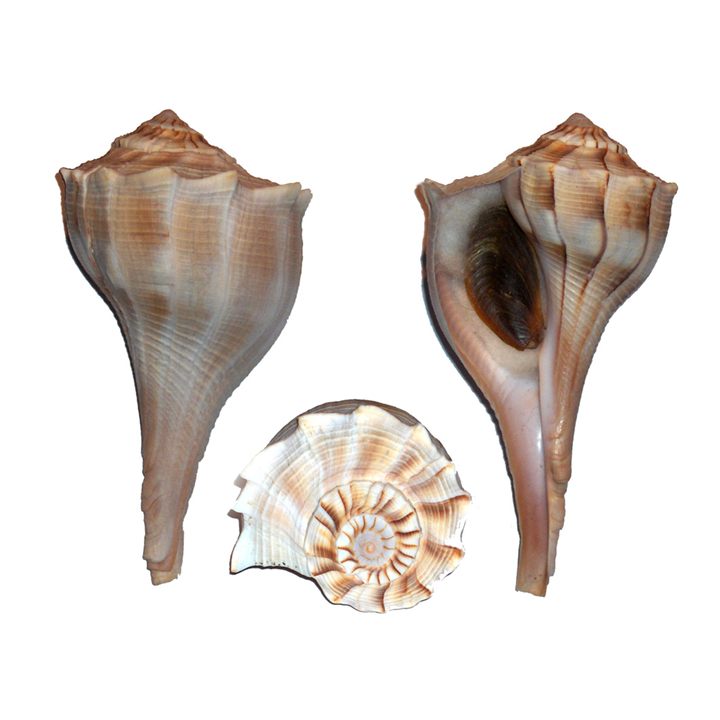
Photo: Clmiadfl (Wikimedia Commons user), Public domain, via Wikimedia Commons
Lightning Whelk
- Typical size
- 4.0 – 16.0 in (10 – 40 cm)
- Group
- Gastropod (sea snail)
- Rarity
- Common species / Prized trophy (large)
- Habitat
- Shallow seagrass flats, barrier island sandbars, and tidal inlets
One of the world's few left-handed (sinistral) gastropods. When held with the spire pointing up, its opening (aperture) is on the left side! Decorated with striking vertical brown and purple lightning streaks.
Quick answer · Quick Identification Verdict
The Lightning Whelk (Sinistrofulgur perversum) is one of the marine world's few left-handed (sinistral) gastropods. When held upright with its spire pointing toward the sky, the shell aperture opens on the left side. Decorated with dynamic vertical wavy streaks of purple, chocolate, and chestnut resembling lightning bolts, it is a formidable predatory snail and one of Southwest Florida's most iconic shore finds.
Lightning Whelk key facts
| Scientific name | Sinistrofulgur perversum (Busyconidae (Busycon whelks)) |
|---|---|
| Typical size | 4.0 – 16.0 in (10 – 40 cm) |
| Rarity | Common species / Prized trophy (large) |
| Where it lives | Shallow seagrass flats, barrier island sandbars, and tidal inlets |
| Best chance to find one | Walking outer barrier spits at sunrise after sustained northwest winds. |
| Opening | Left-opening (Sinistral) |
| OK to collect? | Only if it is empty. If an animal is inside, return it to the water. Live shelling is banned in Lee County, Florida (Sanibel, Captiva, Fort Myers Beach). |
How to identify a Lightning Whelk: Diagnostic Field Checklist
Confirm your find against these primary diagnostic characteristics:
- Sinistral chirality: aperture opens to the LEFT when spire is pointed upward
- Vertical zigzag or wavy streaks of brown, purple, and gray resembling lightning bolts
- Spire bordered by blunt, triangular shoulder spines
- Gracefully elongated straight siphonal canal
- Pale cream to peach-glazed interior enamel
Key Diagnostic Anatomy
Tap to collapse / expand
Examine these anatomical features to distinguish this specimen with certainty:
- Shape & Profile: Heavy pyriform (pear-shaped) body with a broad, low-to-medium conical spire. Each whorl forms an expanded shoulder circled by a ring of blunt triangular tubercles.
- Aperture & Lip: Broad, expansive aperture positioned on the left side of the central axis, tapering smoothly into a long, open siphonal canal. The outer lip is smooth and thin in rapidly growing juveniles, becoming thickened and heavy in old adults.
- Columella (Inner Pillar): Leftward-twisting columella without folds or pleats, coated in a glossy enamel wash ranging from ivory to pale apricot.
- Coloration & Markings: In juveniles and pristine young adults, the shell displays vibrant axial flames of chocolate-brown, plum-purple, and fawn. In large mature adults, the outer surface often weathers to chalky gray or ivory with color streaks concentrated near the shoulder.
Identifying Worn, Weathered & Broken Finds
Even after decades of wave tumbling have bleached away every lightning streak and ground off the shoulder spines, the sinistral orientation remains permanently diagnostic. With the pointed apex held upright facing you, if the opening and spiral whorl curve downward on the left, the specimen belongs to the naturally sinistral Lightning Whelk. In Southwest Florida coastal waters, other large whelks (such as the Knobbed Whelk and Pear Whelk) open on the right.
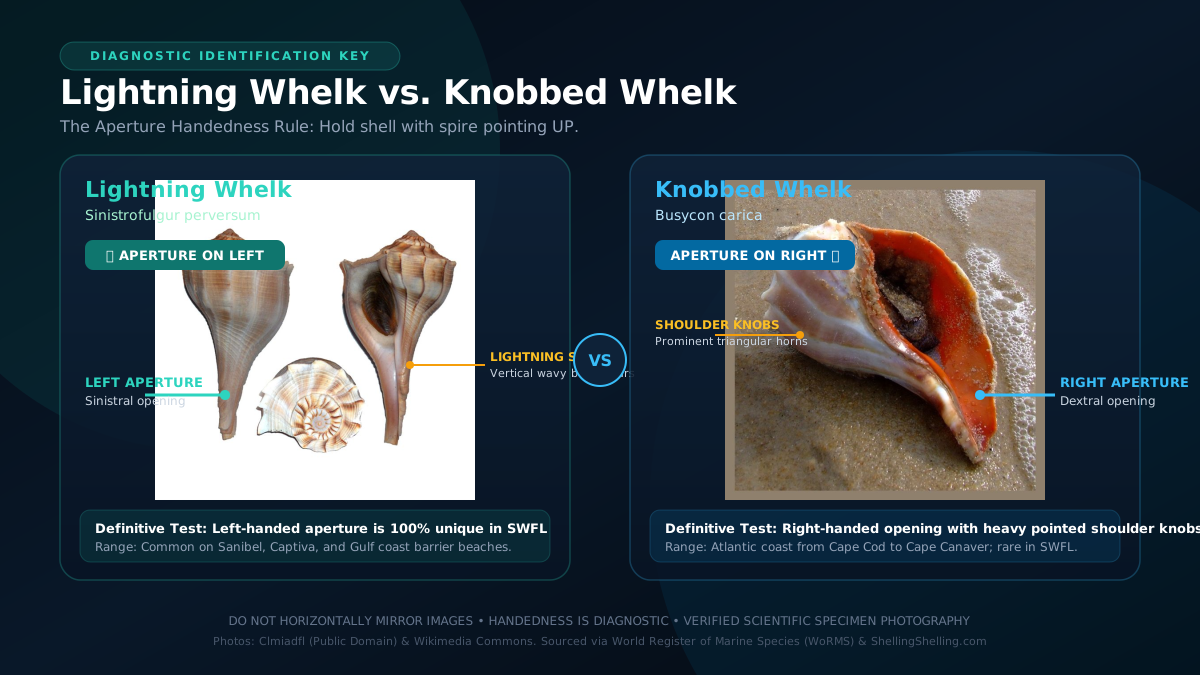
Diagnostic Visual Key: Sinistral vs. Dextral Whelk Chirality
Left-handed vs. right-handed handedness test: the aperture opens to the left when the spire points upward.
Common Lookalikes & How to Tell Them Apart
Knobbed Whelk
Right-opening (dextral) whelk with sharp, prominent shoulder tubercles and no wavy lightning streaks; predominantly an Atlantic coast species.
Pear Whelk
Right-opening (dextral) whelk featuring a distinctive channelled gutter circling the spire suture and a thinner, fragile shell.
Distribution, Depth & Regional Reality
Geographic Range: Endemic to the southeastern United States and Gulf of Mexico, from North Carolina southward around Florida to the Texas coast and Yucatan Peninsula.
Southwest Florida Reality: Abundant throughout Pine Island Sound, San Carlos Bay, and the Gulf barrier shores of Sanibel, Captiva, and Marco Island. Lightning Whelks are active benthic predators that feed on bivalves (clams, oysters, pen shells) by grasping them with their powerful muscular foot and using the edge of their shell lip as a chisel to pry open the valves.
Realistic Search Timing: Winter negative low tides (especially during full and new moons) expose broad sandy flats and sandbars near Blind Pass and Lighthouse Point where empty whelk shells deposit in swash troughs. Juvenile specimens (2–4 inches) are common; giant 10-to-14-inch trophies are typically found after strong winter storms.
Recognizing Living Animals & Conservation Regulations
How to check if the shell is alive or occupied
Living whelks possess a thick, leathery, dark-brown or black horny operculum (trapdoor) firmly attached to the foot. When disturbed, the snail pulls its foot inside and seals the opening shut with this operculum. A heavy shell with an operculum in place is always alive. Also inspect empty shells for hermit crabs.
Florida Wildlife Rules & Local Shelling Ordinances
Under Lee County Ordinance 89-08 and Florida state marine conservation laws, harvesting live whelks is strictly banned. Violations carry mandatory court appearances and fines. Only collect dry, uninhabited shells found above the active surf zone.
Lightning Whelk: common questions
How do I identify a Lightning Whelk?
The Lightning Whelk (Sinistrofulgur perversum) is one of the marine world's few left-handed (sinistral) gastropods. When held upright with its spire pointing toward the sky, the shell aperture opens on the left side. Decorated with dynamic vertical wavy streaks of purple, chocolate, and chestnut resembling lightning bolts, it is a formidable predatory snail and one of Southwest Florida's most iconic shore finds.
Where and when are you most likely to find a Lightning Whelk?
Walking outer barrier spits at sunrise after sustained northwest winds.
What is the Lightning Whelk most often confused with?
The Knobbed Whelk. The Knobbed Whelk opens on the RIGHT; the Lightning Whelk opens on the LEFT. Handedness is the primary diagnostic feature distinguishing these two species.
Can I collect a Lightning Whelk in Florida?
Only if it is empty. If an animal is inside, return it to the water. Live shelling is banned in Lee County, Florida (Sanibel, Captiva, Fort Myers Beach).
Scientific Review & Authoritative Sources
Tap to view citations & review criteria
Primary Authoritative References
- World Register of Marine Species (WoRMS): WoRMS taxon details for Sinistrofulgur perversum (Linnaeus, 1758), AphiaID 744274.
- Malacolog 4.1.1: Western Atlantic Gastropoda: Academy of Natural Sciences of Drexel University: Sinistrofulgur perversum species database.
- Lee County Code of Ordinances: Chapter 14: Live Shelling Conservation Prohibition: Lee County Ordinance 89-08.