Lightning Whelk vs. Knobbed Whelk
Learn how to tell a Lightning Whelk from a Knobbed Whelk: Left-handed vs right-handed aperture orientation, shoulder thorns, and geographic ranges.
When comparing these two species, aperture handedness is the primary diagnostic distinction: hold the specimen vertically with the pointed spire (apex) facing UP and the aperture facing you. In the vast majority of specimens, a left-opening aperture indicates a Lightning Whelk (Sinistrofulgur perversum), which is predominantly sinistral. A right-opening aperture in this genus pair indicates a Knobbed Whelk (Busycon carica), though beachcombers should also consider other dextral species such as the Channeled Whelk or Pear Whelk.
The 3-Second Aperture Handedness Test
Step 1: Orient the specimen so the sharp, pointed tip (the apex or spire) points directly toward 12 o'clock (straight up).
Step 2: Turn the shell so the long open canal and aperture face directly toward you.
Step 3: Look at which side of the central axis the opening lies on. If the opening is on the LEFT side, you are holding a left-handed Lightning Whelk. If the opening is on the RIGHT side, within this species pair it is a Knobbed Whelk (note that other Atlantic/Gulf whelks like Channeled Whelk or Pear Whelk also open on the right).
Biological Note: Biological Note: In malacology, over 90% of all marine gastropod species are dextral (right-handed). The Lightning Whelk is one of the very few large predatory gastropods on Earth that naturally evolved sinistral (left-handed) chirality as its standard morphology.
Diagnostic Visual Key & Anatomical Alignment
Specimens are aligned intentionally with spires upward in natural view (never horizontally mirrored). Real specimen photography and programmatic labels show definitive morphological distinctions.
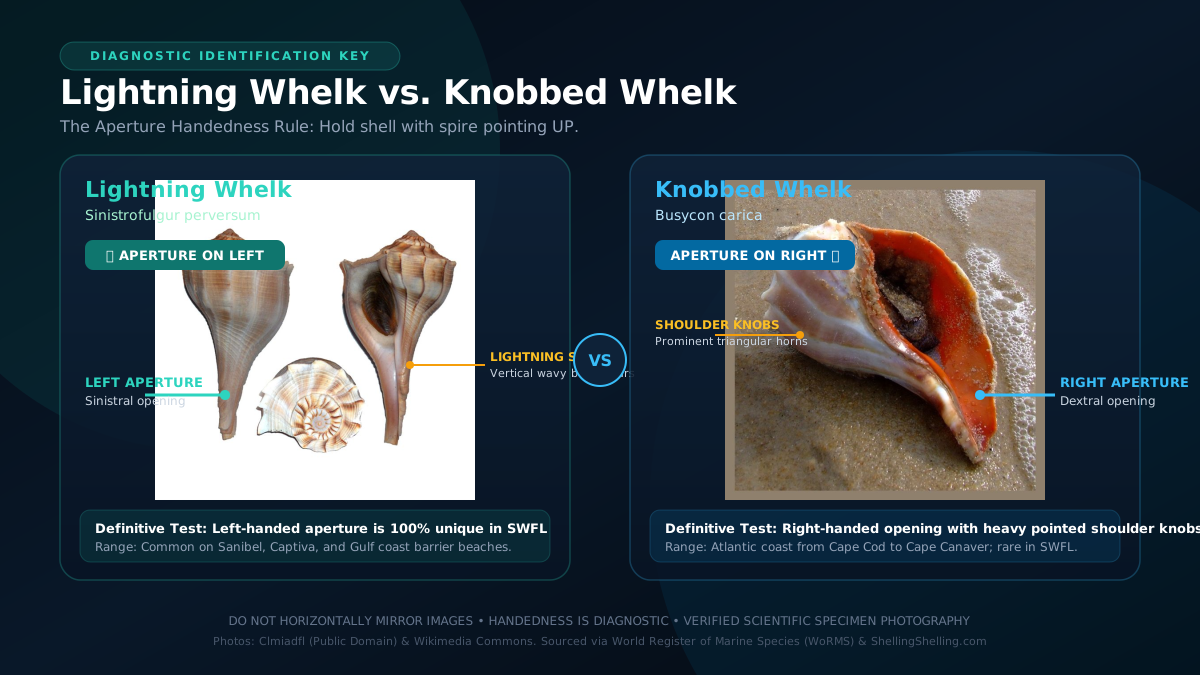
Real Specimen Photography & Diagnostic Points
Authentic museum specimen photographs aligned apex-up in standard view for rigorous anatomical comparison:
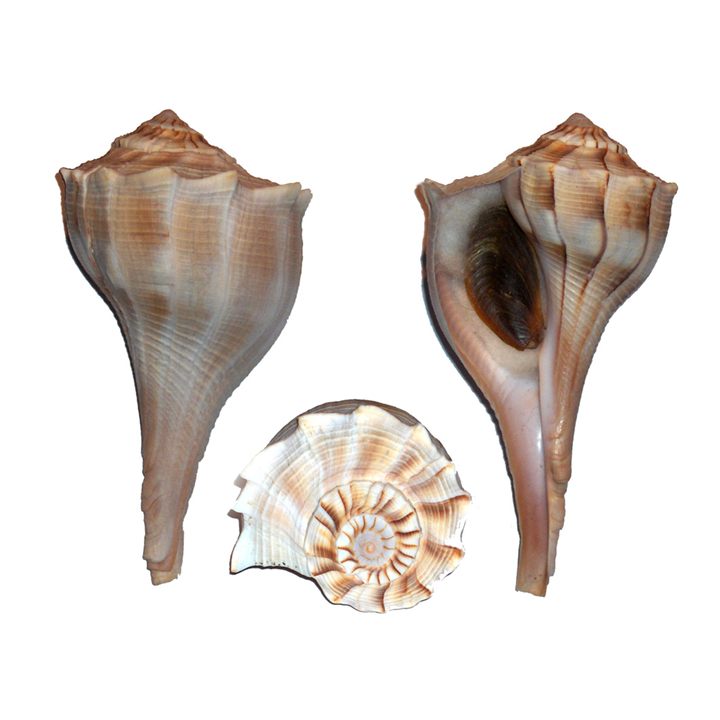
Lightning Whelk
- Aperture opens on the LEFT side when held upright (apex facing up)
- Spire whorls coil counter-clockwise downward to the left
- Wavy vertical purple-brown 'lightning' stripes (vivid in juveniles)
- Shoulder knobs are present but usually blunt or reduced on large adults
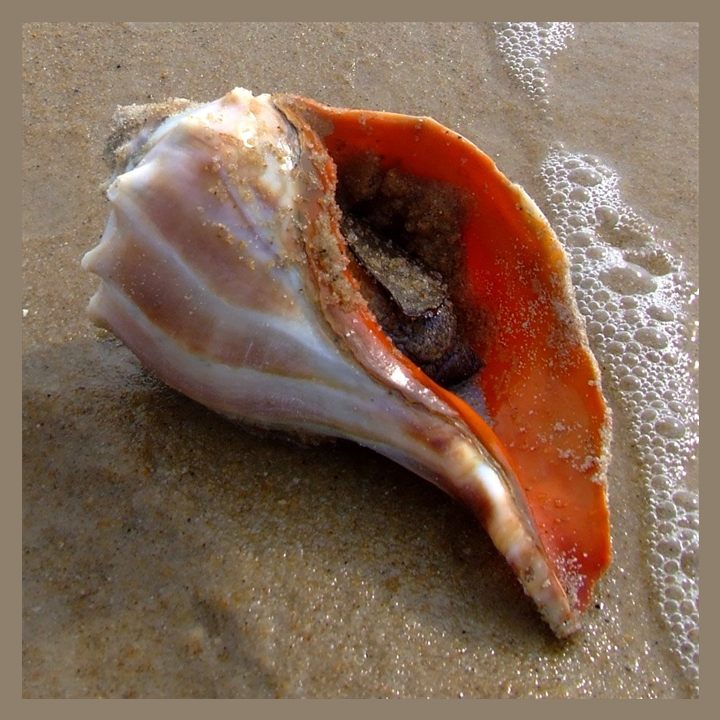
Knobbed Whelk
- Aperture opens on the RIGHT side when held upright (apex facing up)
- Spire whorls coil clockwise downward to the right
- Crown of prominent, heavy, triangular horns/knobs around the shoulder
- Stouter shell wall with warm orange or yellowish glaze inside the aperture
Side-by-Side Comparison Table
Compare anatomical structures, spire proportions, and geographic distributions directly:
| Diagnostic Trait | Lightning Whelk | Knobbed Whelk |
|---|---|---|
| Aperture Orientation (Apex Up) | 👈 LEFT-OPENING (Sinistral) | 👉 RIGHT-OPENING (Dextral) |
| Spire Coiling Direction | Counter-clockwise (sinistral spiral) | Clockwise (dextral spiral) |
| Shoulder Morphology | Blunt or moderately low spines; large adults often smooth | Crown of heavy, prominent triangular knobs |
| Juvenile Color Markings | Vertical zigzag fawn, purple, and brown lightning streaks | Muted brownish-tan axial streaks on pale cream |
| Aperture Interior Color | White, ivory, or pale peach; rarely deep orange | Deep apricot, yellow-orange, or terracotta glaze |
| Maximum Adult Size | Up to 16 inches (40 cm) in warm southern Gulf waters | Up to 9–12 inches (23–30 cm) along Atlantic banks |
| Primary Geographic Range | Gulf of Mexico & Florida shores (abundant in SWFL) | Atlantic Coast (Massachusetts to central Florida) |
| State Shell Honor | Official State Shell of Texas (designated 1987) | Official State Shell of Georgia (1987) & New Jersey (1995) |
Annotated Diagnostic Details
Shoulder Spines & Crown Architecture
A mature Knobbed Whelk (Busycon carica) features a distinct crown of sharp, triangular, outward-pointing tubercles circling every suture of the body whorl. In contrast, the Lightning Whelk (Sinistrofulgur perversum) has lower, rounded spines that frequently diminish into a smooth shoulder slope as the animal reaches giant adult proportions (10+ inches).
Aperture Interior & Shell Weight
Knobbed Whelks possess an exceptionally thick, heavy shell wall designed to withstand cold Atlantic surf. The interior of the aperture typically displays a vivid, rich orange or reddish-yellow glaze. Lightning Whelks have a somewhat thinner, more graceful shell wall, with interior aperture color tending toward creamy white, soft peach, or pale violet.
Geographic Range Overlap
On Southwest Florida Gulf beaches (Sanibel, Captiva, Marco Island), virtually 100% of large whelks encountered are Lightning Whelks. Knobbed Whelks do not maintain breeding populations in the warm, shallow waters of the Florida Gulf shelf. Along the northern Atlantic coast of Florida and Georgia, however, both species can occasionally be found in proximity.
Worn, Weathered & Juvenile Exceptions
Tumbled beach specimens and broken shards often lose delicate features. Use these rules for non-standard finds:
Beach-Worn Fragments & Broken Spires
Waves and tumbling shell gravel often shear off the thin outer lip or break away the pointed spire tip. However, you can still definitively identify broken fragments: examine the central columellar axis. In a Lightning Whelk, the spiral twist descends down and to the left; in a Knobbed Whelk, the inner pillar coils clockwise to the right. The chirality cannot be worn away by surf action.
Juvenile Specimens (Under 3 Inches)
Juvenile Lightning Whelks display spectacular, high-contrast purple-brown lightning streaks running vertically across pale ivory whorls. Juvenile Knobbed Whelks have more subdued brownish bands and develop sharp shoulder points very early in growth.
Dextral Lightning Whelk Mutations (Extremely Rare)
Reversed chirality (a sinistral Knobbed Whelk or a dextral Lightning Whelk) is an exceptionally rare developmental anomaly in gastropods. When encountering an atypical specimen, malacologists examine suture channel depth, shoulder spines, and protoconch morphology rather than handedness alone.
Still Unsure What You Found?
If your specimen is heavily broken, faded, or does not clearly match either description above, take these next steps:
- Try the Interactive Identifier: Answer three simple physical questions in our 3-Step Shell Identifier to test against 24 common Atlantic and Gulf species.
- Inspect the Full Species Guides: Check the comprehensive diagnostic checklists in our Lightning Whelk Guide and Knobbed Whelk Guide.
- Explore More Lookalikes: Compare other commonly confused species in our Lookalike Comparisons Hub or the homepage Lookalikes Lab.
- Living Animal Check: Always check the aperture and siphonal canal for a living occupant or hermit crab. Return any live creature immediately to the water.
Scientific Review & Authoritative Sources
Primary Authoritative References
- World Register of Marine Species (WoRMS): WoRMS Taxon Details: Sinistrofulgur perversum (Linnaeus, 1758) & Busycon carica (Gmelin, 1791).
- Bailey-Matthews National Shell Museum: Sanibel Seashell Guide: Sinistral gastropod morphology and predatory behavior.
- Malacolog 4.1.1 Database: Western Atlantic Gastropoda: Chirality distribution and geographic range mapping.