Junonia vs. Scotch Bonnet
How to tell a Junonia from a Scotch Bonnet: Spindle volute shape vs rounded helmet, neat spiral square spots vs checkered grid markings.
Look at the shell's silhouette and outer lip: A Junonia (Scaphella junonia) is a slender, elongated spindle with a tall pointed spire, smooth toothless outer lip, and dark chocolate square spots. A Scotch Bonnet (Semicassis granulata) is a rounded, globose helmet shell with a short spire, a thick outer lip armed with distinct tooth-like ridges, and amber-gold squares arranged along spiral grooves.
The 2-Point Silhouette & Lip Test
Check 1 — Outer Lip Texture: Run your thumb along the outer lip of the opening. If the lip is thin, smooth, and blade-like with no teeth, it is a Junonia volute. If the lip is heavy, thickened like a rounded rim, and armed with distinct tooth-like ridges (denticulations), it is a Scotch Bonnet helmet.
Check 2 — Overall Body Silhouette: Set the shell flat on a surface. A Junonia has a streamlined, aerodynamic spindle shape (like a slender football or cone) with a high spire that accounts for roughly one-third of the shell's length. A Scotch Bonnet has a chubby, bulbous, egg-like helmet shape with a sunken or very short spire.
Biological Note: Family Distinction: The Junonia is a true Volute (family Volutidae), which are predatory carnivores that deposit deep-water egg capsules. The Scotch Bonnet is a Bonnet/Helmet shell (family Cassidae), which specialize in feeding on sea urchins and sand dollars by drilling neat holes through their spines.
Diagnostic Visual Key & Anatomical Alignment
Specimens are aligned intentionally with spires upward in natural view (never horizontally mirrored). Real specimen photography and programmatic labels show definitive morphological distinctions.
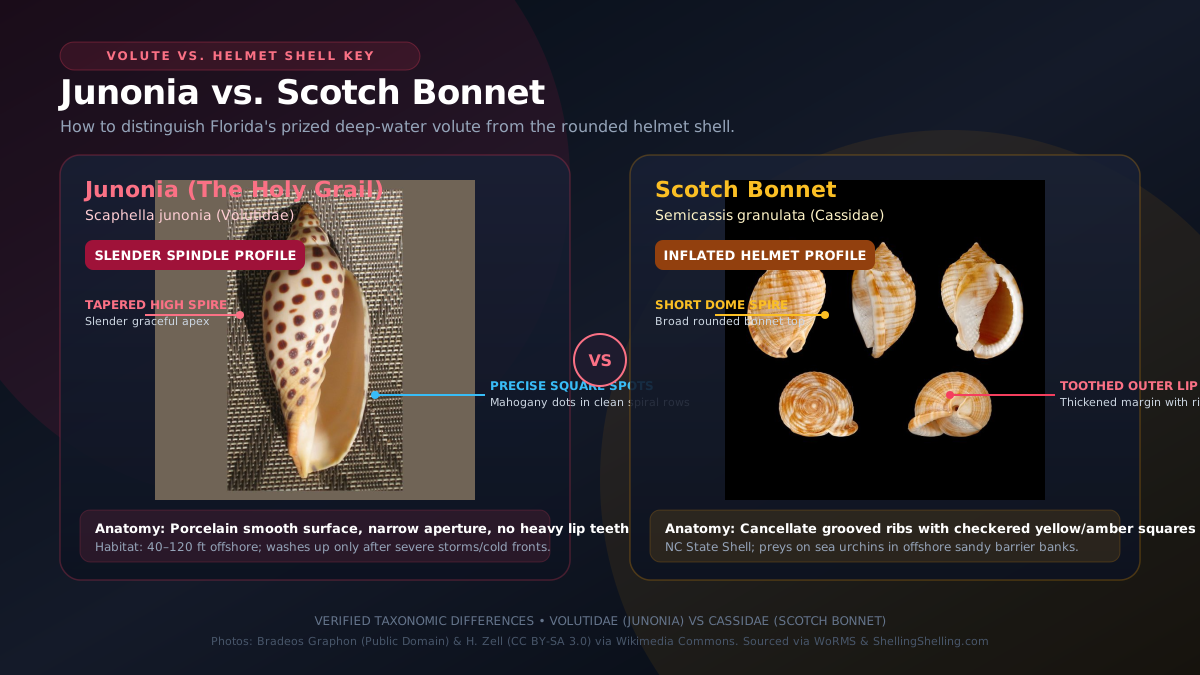
Real Specimen Photography & Diagnostic Points
Authentic museum specimen photographs aligned apex-up in standard view for rigorous anatomical comparison:
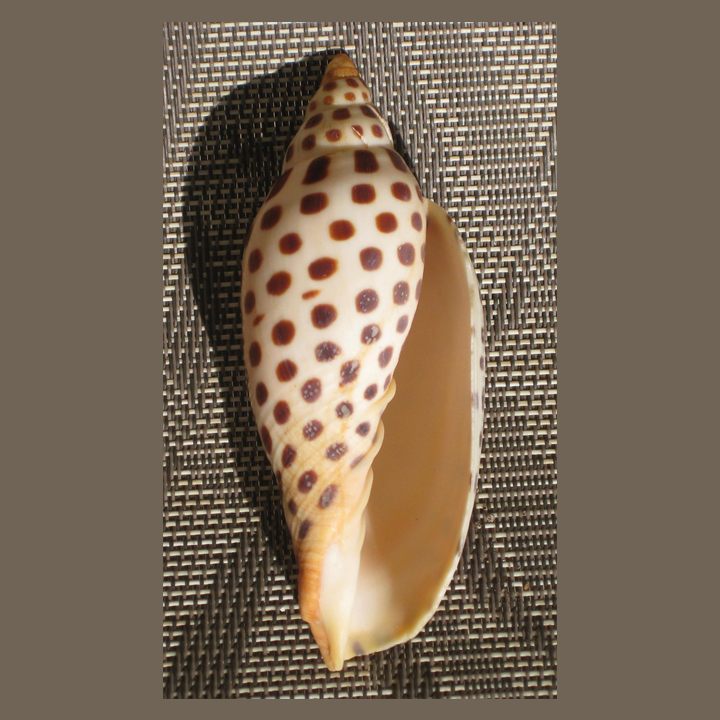
Junonia
- Elongated spindle profile with a tall, gently tapering pointed spire
- Neat spiral rows of crisp, dark chocolate-brown square spots
- Smooth, thin, unthickened outer lip with zero teeth or denticulations
- Columella (inner pillar) features 4 to 5 prominent oblique spiral folds (plicae)
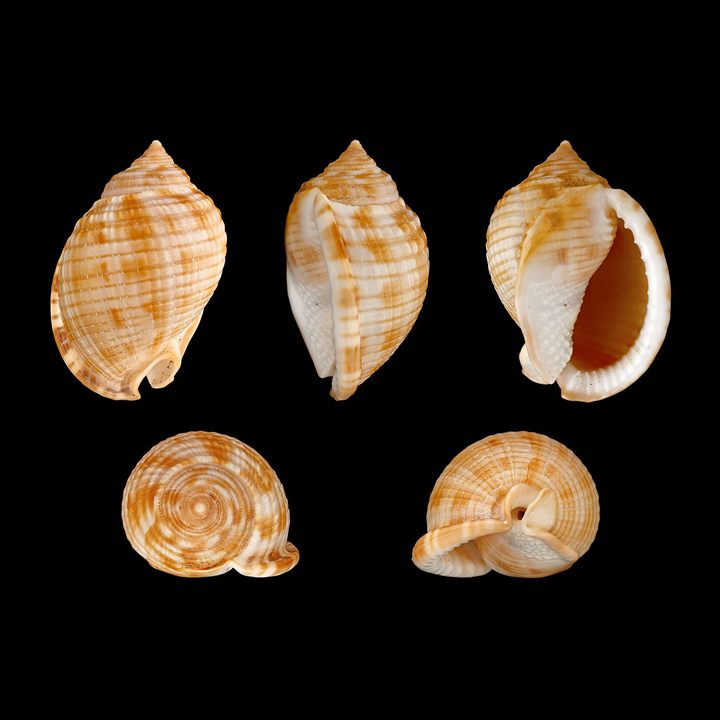
Scotch Bonnet
- Globose, inflated helmet shape with a very short, rounded spire
- Checkered amber, yellowish, or golden-brown squarish blotches
- Heavily thickened outer lip (varix) lined with strong tooth-like ridges
- Wide flattened parietal shield / callus plastered over the inner body whorl
Side-by-Side Comparison Table
Compare anatomical structures, spire proportions, and geographic distributions directly:
| Diagnostic Trait | Junonia | Scotch Bonnet |
|---|---|---|
| Taxonomic Family | Volutidae (Volutes) | Cassidae (Helmet & Bonnet Shells) |
| Shell Silhouette | Slender, elongated spindle / football shape | Globose, rounded, inflated helmet shape |
| Spire Proportion | Tall, sharply pointed (approx. 30–35% of length) | Short, blunt, dome-like spire |
| Outer Lip Structure | Thin, smooth, non-thickened edge (no teeth) | Heavy, thickened rim armed with tooth-like ridges |
| Spot Color & Placement | Deep mahogany/chocolate squares on flat cream | Amber, yellowish-brown squares over spiral cords |
| Surface Texture | Smooth porcelain finish (subtle growth lines) | Sculptured with shallow spiral grooves and cords |
| Columellar Base | 4 to 5 prominent oblique winding ridges (plicae) | Broad flattened parietal shield with pustules |
| Typical Rarity | Very Rare (#1 Holy Grail beach find in SWFL) | Uncommon to Rare (NC State Shell; prized find) |
Annotated Diagnostic Details
Spot Geometry: Clean Spiral Rows vs. Checkered Cords
On a Junonia (Scaphella junonia), the square spots are crisp, rich mahogany brown or almost black, aligned in orderly spiral tracks across a creamy white porcelain background. On a Scotch Bonnet (Semicassis granulata), the squares are typically warm amber-honey, tan, or yellowish-brown, and they sit on slightly raised spiral ribbons that circle the shell like latitude lines.
Aperture & Columella Anatomy
Look deep inside the aperture at the central inner pillar (columella). The Junonia exhibits classic volute architecture: several strong, diagonal spiraling ridges (plicae) winding upward into the interior. The Scotch Bonnet exhibits classic cassid architecture: a glossy, expanded enamel glaze (parietal shield) spreading across the body whorl with tiny bumps or wrinkles near the base.
Habitat & Shelling Realities
Living Junonias dwell in deep offshore waters (90 to 400+ feet deep) on the sandy continental shelf; they never live in shallow beach surf. Finding a Junonia on Sanibel or Marco Island requires severe winter storm swells or tropical systems that tumble heavy benthic shells shoreward. Scotch Bonnets live somewhat closer to shore (20 to 150 feet) on offshore sand flats and urchin beds, frequently washing up along the North Carolina Outer Banks and eastern Florida shores.
Worn, Weathered & Juvenile Exceptions
Tumbled beach specimens and broken shards often lose delicate features. Use these rules for non-standard finds:
Beach-Worn Junonia Shards
Because Junonias are rolled long distances across offshore shell beds by heavy storms, beachcombers frequently find broken halves, fractured spires, or lip shards. To confirm a worn Junonia fragment: look for the distinct diagonal columellar folds (plicae) on the inner column, and verify that the interior surface is creamy white porcelain without teeth.
Faded & Sun-Bleached Scotch Bonnets
Old Scotch Bonnets exposed to sun and surf often lose their amber spots entirely, fading to chalky white or dull tan. Even with zero visible color spots, the heavily thickened outer lip lined with tooth-like ridges and the short helmet dome immediately identify it as Semicassis granulata.
Still Unsure What You Found?
If your specimen is heavily broken, faded, or does not clearly match either description above, take these next steps:
- Try the Interactive Identifier: Answer three simple physical questions in our 3-Step Shell Identifier to test against 24 common Atlantic and Gulf species.
- Inspect the Full Species Guides: Check the comprehensive diagnostic checklists in our Junonia Guide and Scotch Bonnet Guide.
- Explore More Lookalikes: Compare other commonly confused species in our Lookalike Comparisons Hub or the homepage Lookalikes Lab.
- Living Animal Check: Always check the aperture and siphonal canal for a living occupant or hermit crab. Return any live creature immediately to the water.
Scientific Review & Authoritative Sources
Primary Authoritative References
- World Register of Marine Species (WoRMS): WoRMS Taxon Details: Scaphella junonia (Lamarck, 1804).
- World Register of Marine Species (WoRMS): WoRMS Taxon Details: Semicassis granulata (Born, 1778).
- Bailey-Matthews National Shell Museum: Diagnostic distinction between deep-shelf Scaphella and coastal Semicassis.
- North Carolina Department of Natural and Cultural Resources: Official state shell history and biological characteristics of Semicassis granulata.