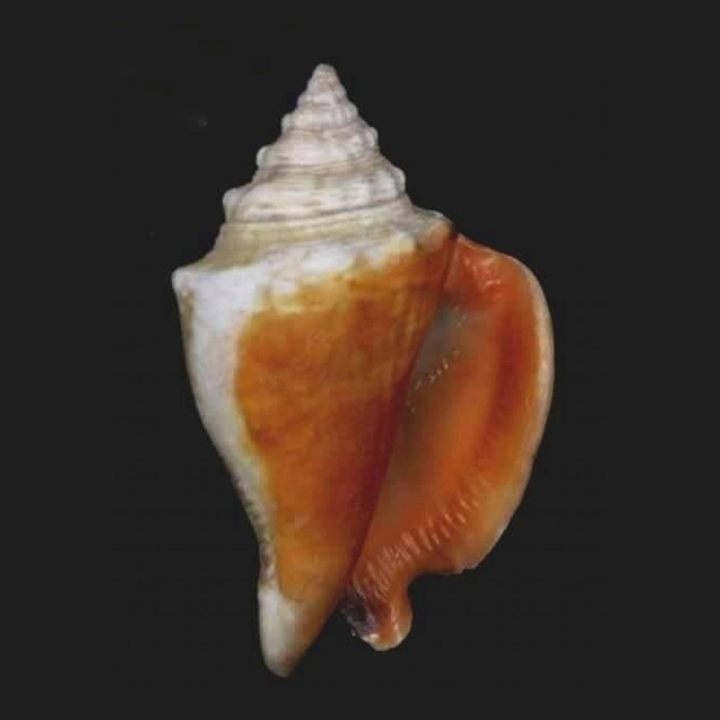
Photo: Naturalis Biodiversity Center, CC BY-SA 4.0, via Wikimedia Commons
Florida Fighting Conch
- Typical size
- 3.0 – 4.5 in (8 – 11 cm)
- Group
- Gastropod (sea snail)
- Rarity
- Abundant
- Habitat
- Shallow sandy flats, seagrass beds, and surf breaker zones
A heavy, conical shell featuring a glossy aperture lip ranging from fiery burnt orange to deep iridescent chocolate. Named for the males' habit of shoving and "fighting" each other; the animal uses its sharp, claw-like operculum to vault itself across the sand.
Quick answer · Quick Identification Verdict
The Florida Fighting Conch (Strombus alatus) is a heavy, robust herbivorous gastropod celebrated for its glossy aperture lip that glows in vibrant shades of fiery burnt orange, amber, and deep iridescent chocolate. Named for the territorial jostling observed among males during breeding season and its active leaping locomotion, it is one of the most frequently found and colorful shells along Florida's Gulf coast.
Florida Fighting Conch key facts
| Scientific name | Strombus alatus (Strombidae (True conchs)) |
|---|---|
| Typical size | 3.0 – 4.5 in (8 – 11 cm) |
| Rarity | Abundant |
| Where it lives | Shallow sandy flats, seagrass beds, and surf breaker zones |
| Best chance to find one | Exposed sandbars during morning low tide. Always check inside the aperture to ensure no hermit crab or living mollusk resides within. |
| Opening | Right-opening (Dextral) |
| OK to collect? | Only if it is empty. If an animal is inside, return it to the water. Live shelling is banned in Lee County, Florida (Sanibel, Captiva, Fort Myers Beach). |
How to identify a Florida Fighting Conch: Diagnostic Field Checklist
Confirm your find against these primary diagnostic characteristics:
- Dextral conical shell with a sharp pointed spire and blunt shoulder spines
- Brilliant, highly glazed aperture interior ranging from fiery orange to chocolate-purple
- Thickened, slightly flared (alate) outer lip
- Distinct stromboid notch near the base of the outer lip (for right eye protrusion)
- Heavy, solid weight that survives surf abrasion
Key Diagnostic Anatomy
Tap to collapse / expand
Examine these anatomical features to distinguish this specimen with certainty:
- Shape & Profile: Solid biconical outline with short, pointed triangular spines encircling the shoulder of each whorl. The body whorl is large and conical, tapering toward a short anterior canal.
- Aperture & Lip: Narrow and elongated with an interior coated in a thick, glass-like enamel. The outer lip flares outward into a smooth wing-like margin.
- Stromboid Notch: A smooth U-shaped indentation near the anterior end of the outer lip. In life, the conch extends its right eye stalk through this specialized window to survey its surroundings while keeping its body shielded beneath the shell.
- Coloration & Markings: Exterior coloration varies from chestnut-brown, amber, and tan to mottled creamy white, often covered in life by a thin yellowish periostracum.
Identifying Worn, Weathered & Broken Finds
Beach-worn Fighting Conchs frequently lose their external brown color and shoulder spine tips to wave tumbling. To identify a weathered specimen: (1) look at the inside of the aperture where the intense orange, reddish-amber, or violet glaze remains vivid even on battered shells, (2) feel the substantial dense weight of the shell wall, and (3) locate the stromboid notch along the lower outer lip margin.
Common Lookalikes & How to Tell Them Apart
Crown Conch
Predatory snail with sharp, curved, hollow crown-like spines along the shoulder and base, patterned in brown-and-white spiral bands.
Florida Horse Conch
State shell of Florida; grows to massive proportions (up to 24 inches) with coarse axial ribs, prominent spiral cords, and a bright orange body.
Distribution, Depth & Regional Reality
Geographic Range: Common throughout the Gulf of Mexico from North Carolina around the Florida Peninsula to the Texas coast.
Southwest Florida Reality: Fighting Conchs are exceptionally prolific around Sanibel Island, Captiva Island, and Marco Island. They form expansive breeding aggregations in shallow subtidal sandbars during late spring and summer. After winter cold fronts or tropical swells, thousands of shells deposit along the wrack lines at Blind Pass and Turner Beach.
Realistic Search Timing: Empty shells can be found year-round along Southwest Florida barrier beaches. Low-tide walks along sandbar drop-offs routinely reveal dozens of clean empty specimens.
Recognizing Living Animals & Conservation Regulations
How to check if the shell is alive or occupied
Because Fighting Conchs live in shallow waters right up to the wave break, a significant percentage of shells found at the water's edge are still alive! Pick up the shell and turn it over: if you see a dark leathery foot with a sharp, sickle-shaped brown operculum or stalked eyes peering back, it is alive. Inactive empty shells are also prime real estate for striped hermit crabs.
Florida Wildlife Rules & Local Shelling Ordinances
Under Lee County Ordinance 89-08 and Florida Fish and Wildlife Conservation Commission rules, taking live conchs is strictly illegal. Always inspect the aperture; if an animal is inside, gently place it back into knee-deep water.
Florida Fighting Conch: common questions
How do I identify a Florida Fighting Conch?
The Florida Fighting Conch (Strombus alatus) is a heavy, robust herbivorous gastropod celebrated for its glossy aperture lip that glows in vibrant shades of fiery burnt orange, amber, and deep iridescent chocolate. Named for the territorial jostling observed among males during breeding season and its active leaping locomotion, it is one of the most frequently found and colorful shells along Florida's Gulf coast.
Where and when are you most likely to find a Florida Fighting Conch?
Exposed sandbars during morning low tide. Always check inside the aperture to ensure no hermit crab or living mollusk resides within.
What is the Florida Fighting Conch most often confused with?
The Crown Conch. The Crown Conch has sharp curved spikes and lacks the glossy orange aperture and stromboid notch of the true Fighting Conch.
Can I collect a Florida Fighting Conch in Florida?
Only if it is empty. If an animal is inside, return it to the water. Live shelling is banned in Lee County, Florida (Sanibel, Captiva, Fort Myers Beach).
Scientific Review & Authoritative Sources
Tap to view citations & review criteria
Primary Authoritative References
- World Register of Marine Species (WoRMS): WoRMS taxon details for Strombus alatus Gmelin, 1791, AphiaID 419702.
- Florida Museum of Natural History: Invertebrate Zoology: Mollusca Collection Database: Strombus alatus range and morphological records.
- Lee County Parks & Recreation: Lee County Beach Regulations & Conservation Ordinance 89-08.