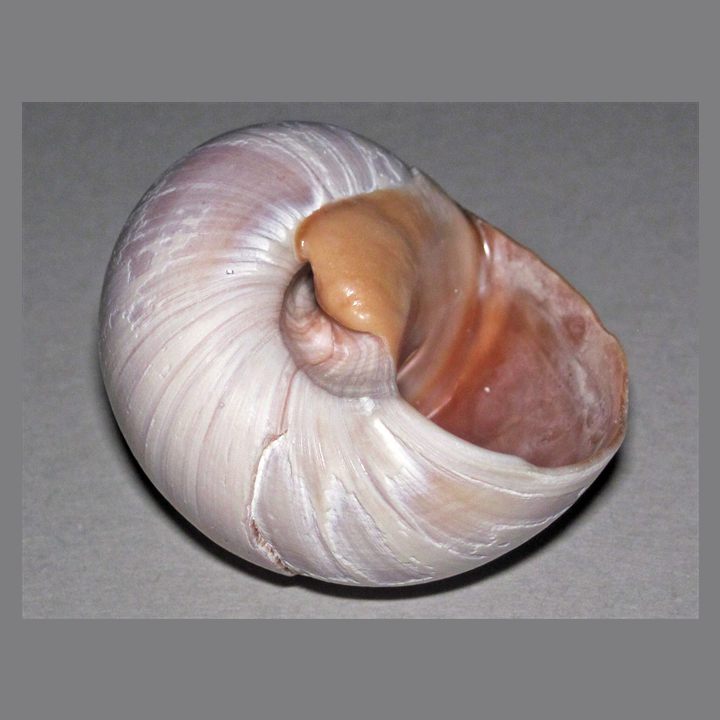
Photo: James St. John, CC BY 2.0, via Wikimedia Commons
Shark Eye
- Typical size
- 1.5 – 3.5 in (4 – 9 cm)
- Group
- Gastropod (sea snail)
- Rarity
- Common Find
- Habitat
- Sandy intertidal and shallow subtidal flats from Massachusetts to the Gulf of Mexico
A glossy, rounded moon snail whose whorls swirl into a dark, bluish-grey 'eye' at the top. Moon snails are predators that drill neat, beveled holes in clams, which is where many holed beach shells come from.
Quick answer · Quick Identification Verdict
Look down on the spire: the whorls form a spiral 'eye' that is often bluish-grey. The shell is smooth, broad and globe-shaped, and a large brown callus partly covers the navel (umbilicus) beside the half-moon aperture.
Shark Eye key facts
| Scientific name | Neverita duplicata |
|---|---|
| Typical size | 1.5 – 3.5 in (4 – 9 cm) |
| Rarity | Common Find |
| Where it lives | Sandy intertidal and shallow subtidal flats from Massachusetts to the Gulf of Mexico |
| Best chance to find one | Common on sandy Gulf and Atlantic beaches at low tide, especially after winter fronts. Check for the animal first: live moon snails have a huge foot. |
| OK to collect? | Only if it is empty. If an animal is inside, return it to the water. Live shelling is banned in Lee County, Florida (Sanibel, Captiva, Fort Myers Beach). |
How to identify a Shark Eye: Diagnostic Field Checklist
Confirm your find against these primary diagnostic characteristics:
- Smooth, glossy, globe-shaped shell with a low spire
- Spiral whorls forming a dark 'eye' when viewed from above
- Large brown callus partly covering the navel next to the aperture
Where and when to find it
Common on sandy Gulf and Atlantic beaches at low tide, especially after winter fronts. Check for the animal first: live moon snails have a huge foot.
Shelling ethics: only collect empty shells. If an animal is inside, return it to the water. Live shelling is banned in Lee County, Florida (Sanibel, Captiva, Fort Myers Beach).
Shark Eye: common questions
How do I identify a Shark Eye?
Look down on the spire: the whorls form a spiral 'eye' that is often bluish-grey. The shell is smooth, broad and globe-shaped, and a large brown callus partly covers the navel (umbilicus) beside the half-moon aperture.
Where and when are you most likely to find a Shark Eye?
Common on sandy Gulf and Atlantic beaches at low tide, especially after winter fronts. Check for the animal first: live moon snails have a huge foot.
Can I collect a Shark Eye in Florida?
Only if it is empty. If an animal is inside, return it to the water. Live shelling is banned in Lee County, Florida (Sanibel, Captiva, Fort Myers Beach).