Turkey Wing
- Typical size
- 2.0 – 4.0 in (5 – 10 cm)
- Group
- Bivalve (two-part shell)
- Rarity
- Common Find
- Habitat
- Attached by threads to rocks and reefs in shallow water from North Carolina to Brazil
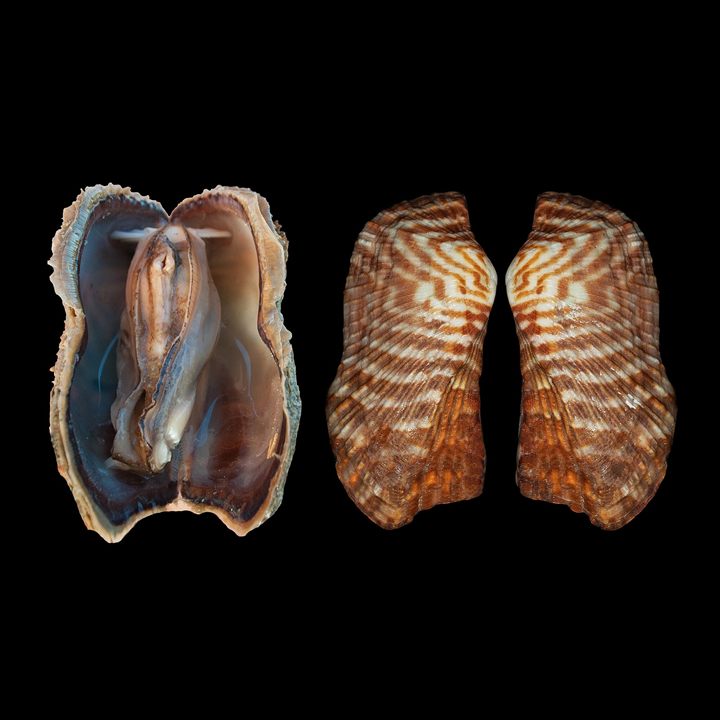
A boxy ark clam with bold reddish-brown zigzag stripes on a cream background, like a turkey's tail feathers. Its long, straight hinge carries many tiny teeth.
Quick answer · Quick Identification Verdict
Look for an elongated, boxy shell with a long straight hinge lined with small comb-like teeth and reddish-brown zigzag stripes. Fine ribs run across the surface.
Turkey Wing key facts
| Scientific name | Arca zebra |
|---|---|
| Typical size | 2.0 – 4.0 in (5 – 10 cm) |
| Rarity | Common Find |
| Where it lives | Attached by threads to rocks and reefs in shallow water from North Carolina to Brazil |
| Best chance to find one | Common in shell piles on Florida's Gulf and Atlantic beaches. |
| OK to collect? | Only if it is empty. If an animal is inside, return it to the water. Live shelling is banned in Lee County, Florida (Sanibel, Captiva, Fort Myers Beach). |
How to identify a Turkey Wing: Diagnostic Field Checklist
Confirm your find against these primary diagnostic characteristics:
- Elongated, boxy shape with a long, straight hinge
- Row of many tiny comb-like teeth along the hinge
- Reddish-brown zigzag stripes on cream
Where and when to find it
Common in shell piles on Florida's Gulf and Atlantic beaches.
Shelling ethics: only collect empty shells. If an animal is inside, return it to the water. Live shelling is banned in Lee County, Florida (Sanibel, Captiva, Fort Myers Beach).
Turkey Wing: common questions
How do I identify a Turkey Wing?
Look for an elongated, boxy shell with a long straight hinge lined with small comb-like teeth and reddish-brown zigzag stripes. Fine ribs run across the surface.
Where and when are you most likely to find a Turkey Wing?
Common in shell piles on Florida's Gulf and Atlantic beaches.
Can I collect a Turkey Wing in Florida?
Only if it is empty. If an animal is inside, return it to the water. Live shelling is banned in Lee County, Florida (Sanibel, Captiva, Fort Myers Beach).